
Press Releases

Water Is High Priority For Americans

Public Has Major Concerns About Expanded Shale Gas Fracking for Exporting to Other Nations;

“Clean Water First” is Clear Choice When Public Weighs Options for More U.S. Energy Production.

Washington, DC /PRNewswire-USNewswire/ – Americans are not opposed to more domestic energy production, but they are unwilling to achieve it by sacrificing clean water, increased energy efficiency, and expanded wind and solar power in the process, according to a major new ORC International survey conducted for the nonprofit Civil Society Institute (CSI) and Environmental Working Group (EWG).

Available at http://www.AmericanCleanEnergyAgenda.org, the December 26-29, 2012 poll of 809 respondents gauges the views of Americans about broad energy production issues and also zeroes in on the recent controversy about the expanded shale gas fracking that would be needed to make possible large-scale liquefied natural gas (LNG) exports to China and other countries.

Key survey findings on broad energy issues include the following:
• 94 percent of Americans – including 92 percent of Republicans, 87 percent of Independents, and 98 percent of Democrats – want political leadership on balancing calls for more energy production in U.S. with protecting clean water and air.
• 91 percent of Americans feel it is important that their member of Congress demonstrate leadership on a “national agenda for clean energy and protecting America’s water and air.” The vast majority of Republicans (85 percent), Independents (87 percent), and Democrats (96 percent) agree on the need for such leadership.
• 92 percent of Americans think “U.S. energy planning and decision making” should be based on “a comprehensive understanding of what our national water resources are” – a national water roadmap that Congress asked for, but which was never produced. The national water roadmap attracts the support of 92 percent of Republicans, 89 percent of Independents, and 94 percent of Democrats.
• 86 percent of Americans want leadership on shifting from coal and nuclear energy to wind and solar. Support for this approach exists across party lines, including 72 percent of Republicans, 83 percent of Independents, and 97 percent of Democrats.

On fracking and LNG exports, key poll findings include:
• 62 percent of Americans oppose “expanding U.S. production of shale gas for use by other nations” first before the health research is done, as recommended recently by more than 100 U.S. health professionals. This approach is supported by about half (49 percent) of Republicans, and over two thirds of Independents and Democrats, at 67 percent and 69 percent, respectively.
• 88 percent of Americans want leadership when it comes to exercising caution on exporting energy – such as natural gas – that could boost China and other economies, but hurt U.S. consumers by raising energy and manufacturing costs at home. Nearly identical support levels were seen here along partisan lines: 88 percent of Republicans, 86 percent of Independents, 87 percent of Democrats.
• 86 percent of Americans “support more studies of the health and environmental consequences of the chemicals” used in fracking. Supporters of this approach include 81 percent of Republicans, 84 percent of Independents, and 89 percent of Democrats.
• Three quarters of Americans have heard of fracking, with 51 percent saying they are very or somewhat familiar with it. 79 percent of Americans are concerned about fracking “as it relates to water quality.”

Pam Solo , president and founder, Civil Society Institute, said: “This survey should be a wake-up call for federal elected officials. The polling data we are releasing today should give pause to decision makers who assume the American public will support energy policies without regard to consequences or the impact these choices have on safe drinking water. The voracious appetite that conventional energy such as gas, oil, coal and nuclear power has on water availability is increasingly a problem for many parts of the country. When given a menu of choices and not asked a simple ‘yes or no’ question, Americans weigh our options and come down in favor of increased energy efficiency and low environmental impact and healthier energy futures such as wind and solar power. The distance between what the public values and where political decision makers are headed should be seen as an opportunity for real leadership at the federal level. Energy policy is at the heart of our economic prosperity, public health, and national security. And Americans overwhelmingly want a voice that can counter the undue influence of the energy industries that have a stake in business as usual.”

“The takeaway from this important poll is that access to clean, safe drinking water is first and foremost on Americans’ minds as we dive headlong into a new era of energy production in the United States,” said Heather White , executive director at Environmental Working Group. “Americans are concerned about water quality, but also water availability when they look at how much is used in the quest for domestic sources of energy. Shale gas drilling or ‘fracking’, nuclear energy and coal production use vast amounts of the natural resource we the people need to survive. That is why the overwhelming majority of Americans want leaders in Washington to shift from coal and nuclear to wind and solar energy. Given the gridlock on Capitol Hill even on its basic responsibilities like avoiding the ‘fiscal cliff,’ most Americans understand that it’ll be up to the public to push the federal government and the country on a truly clean energy path.”

Wayne Russum , senior vice president, ORC International, said: “This new survey shows that Americans are fine with more energy production in the U.S., but they are not willing to trade away clean water and air to make it happen. The poll findings indicate that Americans want political leadership that takes a balanced approach to production of energy – protecting clean water and air, and also promoting expanded energy efficiency and clean energy sources. Significantly, views are largely the same regardless of whether Americans are asked in the ‘abstract’ about general energy issues or when the focus shifts to a concrete energy issue, such as shale gas fracking or the exporting of liquefied natural gas.”

Anthony Ingraffea , Dwight C. Baum professor of engineering, Cornell University, and president, Physicians, Scientists, and Engineers for Healthy Energy, said: “These poll findings clearly indicate that Americans, regardless of political affiliation, can differentiate between a fossil fuel corporate business plan and a national clean-energy-now policy. They overwhelmingly recognize that the continued absence of such a policy invites continued threats to clean water and air, and accelerated global warming. They can see through the charade of LNG exports for what they would be: another fossil fuel industry afterthought that seeks to restore profitability to the shale gas industry at the expense of further abuse of the environment and human health.”

Other key survey findings include the following:

• 86 percent of Americans think “the availability of ample clean drinking water should be a top national priority in the U.S.”
• 80 percent of Americans think we “should get the facts first about health and environmental risks before the potential damage is done by energy production.” This “precautionary principle” approach is supported by 67 percent of Republicans, 82 percent of Independents, and 89 percent of Democrats.
• 86 percent of Americans want leadership on addressing climate change and extreme weather. Relatively little partisan difference is seen on this point, with support for action coming from 75 percent of Republicans, 82 percent of Independents, and 95 percent of Democrats.
• Only 17 percent of Americans favor development of U.S. energy resources for export purposes “to advance U.S. interests as a global economic power” versus 81 percent who think “America should produce enough energy to meet America’s needs in a way that doesn’t harm our clean water and air …”
•How concerned are Americans about the possible impact of “drought and shortages brought on by the diversion of water for energy and other purposes?” ◦ 91 percent are concerned about higher food prices.
◦ 90 percent are concerned about “possible shortages of safe drinking water.” More than three out of four Americans (76 percent) are “very concerned” about such shortages.
◦ 89 percent are concerned about higher gasoline prices.
◦ 87 percent are concerned about increased water utility bills.
◦ 73 percent are concerned about diminished recreation opportunities.

• 74 percent think a grassroots movement will be needed “to counter the influence of energy industry lobbyists and campaign contributions on politicians in Washington, D.C.”
• 86 percent of Americans want leadership on standing up to pressure from coal, oil, natural gas, and nuclear power lobbyists.

On October 15, 2012, 100 grassroots organizations with roughly 2,000,000 members nationwide issued a “First 100 Days” clean energy agenda for the next President of the United States. The full text of the agenda is available online at http://www.AmericanCleanEnergyAgenda.org. The “American Clean Energy Agenda” was first agreed on in outline form by participating groups in June 2012.

Methodology
ORC International conducted the telephone survey among two national probability samples, which, when combined, consisted of 809 adults, 426 men and 383 women 18 years of age and older, living in the continental United States. Interviewing was completed on December 26-29, 2012. A total of 529 interviews were from the landline sample and 280 interviews from the cell phone sample. The margin of error for the combined samples is plus or minus 3 percent.

About The Groups
Based in Newton, MA, the nonprofit and nonpartisan Civil Society Institute (http://www.CivilSocietyInstitute.org) is a think tank that serves as a catalyst for change by creating problem-solving interactions among people, and between communities, government and business that can help to improve society. Since 2003, CSI has conducted more than 25 major national and state-level surveys and reports on energy and auto issues, including vehicle fuel-efficiency standards, consumer demand for hybrids/other highly-fuel efficient vehicles, global warming and renewable energy. In addition to being a co-convener of TheCLEAN.org (http://www.TheClean.org), the Civil Society Institute also is the parent organization of the Hybrid Owners of America (http://www.HybridOwnersofAmerica.org).

EWG is a nonprofit research organization based in Washington, D.C. that uses the power of information to protect human health and the environment. http://www.ewg.org.

SOURCE: Civil Society Institute, Newton, MA and Environmental Working Group, Washington, DC

What is Stormwater?

Stormwater is water that originates during precipitation events. It may also be used to apply to water that originates with snowmelt that enters the stormwater attenuation system. Stormwater that does not soak into the ground becomes surface runoff, which either flows directly into surface waterways or is channeled into storm sewers, which eventually discharge to surface waters.

Stormwater is of concern for two main issues: one related to the volume and timing of runoff water (flood control and water supplies) and the other related to potential contaminants that the water is carrying, i.e. water pollution.

Stormwater is also a resource and ever growing in importance as the world’s human population demand exceeds the availability of readily available water. Techniques of stormwater harvesting with point source water management and purification can potentially make urban environments self-sustaining in terms of water.

Since humans began living in concentrated village or urban settings, stormwater runoff has been an issue. During the Bronze Age, housing took a more concentrated form, and impervious surfaces emerged as a factor in the design of early human settlements. Some of the early incorporation of stormwater engineering is evidenced in ancient Greece.1

A specific example of an early stormwater runoff system design is found in the archaeological recovery at Minoan Phaistos on Crete.2

Because impervious surfaces (parking lots, roads, buildings, compacted soil) do not allow rain to infiltrate into the ground, more runoff is generated than in the undeveloped condition. This additional runoff can erode watercourses (streams and rivers) as well as cause flooding after the stormwater attenuation collection system is overwhelmed by the additional flow. Because the water is flushed out of the watershed during the storm event, little infiltrates the soil, replenishes groundwater, or supplies stream baseflow in dry weather.3

Pollutants entering surface waters during precipitation events is termed polluted runoff. Daily human activities result in deposition of pollutants on roads, lawns, roofs, farm fields, etc. When it rains or there is irrigation, water runs off and ultimately makes its way to a river, lake, or the ocean. While there is some attenuation of these pollutants before entering the receiving waters, the quantity of human activity results in large enough quantities of pollutants to impair these receiving waters.

In addition to the pollutants carried in stormwater runoff, urban runoff is being recognized as a cause of pollution in its own right. In natural catchments (watersheds) surface runoff entering waterways is a relatively rare event, occurring only a few times each year and generally after larger storm events. Before development occurred most rainfall soaked into the ground and contributed to groundwater recharge or was recycled into the atmosphere by vegetation through evapotranspiration.

Modern drainage systems which collect runoff from impervious surfaces (e.g., roofs and roads) ensure that water is efficiently conveyed to waterways through pipe networks, meaning that even small storm events result in increased waterway flows.

In addition to delivering higher pollutants from the urban catchment, increased stormwater flow can lead to stream erosion, encourage weed invasion, and alter natural flow regimes. Native species often rely on such flow regimes for spawning, juvenile development, and migration.

In some areas, especially along the U.S. coast, polluted runoff from roads and highways may be the largest source of water pollution. For example, about 75 percent of the toxic chemicals getting to Seattle, Washington’s Puget Sound are carried by stormwater that runs off paved roads and driveways, rooftops, yards, and other developed land.4

Managing the quantity and quality of stormwater is termed, “Stormwater Management.”5 The term Best Management Practice (BMP) is often used to refer to both structural or engineered control devices and systems (e.g. retention ponds) to treat polluted stormwater, as well as operational or procedural practices. Stormwater management includes both technical and institutional aspects, including6:
• manage stormwater to control flooding and erosion;
• manage and control hazardous materials to prevent release of pollutants into the environment (source control);
• plan and construct stormwater systems so contaminants are removed before they pollute surface waters or groundwater resources;
• acquire and protect natural waterways where they still exist or can be rehabilitated;
• build “soft” structures such as ponds, swales or wetlands or newer Green Infrastructure solutions to work with existing or “hard” drainage structures, such as pipes and concrete channels;
• revise current stormwater regulations to address comprehensive stormwater needs;
develop funding approaches to stormwater programs potentially including stormwater user fees;
develop long-term asset management programs to repair and replace aging infrastructure;
enhance and enforce existing ordinances to make sure property owners consider the effects of stormwater before, during and after development of their land;
educate a community about how its actions affect water quality, and about what it can do to improve water quality; and
plan carefully to create solutions before problems become too great
Integrated water management (IWM) of stormwater has the potential to address many of the issues affecting the health of waterways and water supply challenges facing the modern urban city.

Also known as low impact development in the United States, or Water Sensitive Urban Design (WSUD)7 in Australia, IWM has the potential to improve runoff quality, reduce the risk and impact of flooding and deliver an additional water resource to augment potable supply.

The development of the modern city often results in increased demands for water supply due to population growth, while at the same time altered runoff predicted by climate change has the potential to increase the volume of stormwater that can contribute to drainage and flooding problems. IWM offers several techniques including stormwater harvest (to reduce the amount of water that can cause flooding), infiltration (to restore the natural recharge of groundwater), biofiltration or bioretention (e.g., rain gardens) to store and treat runoff and release it at a controlled rate to reduce impact on streams and wetland treatments (to store and control runoff rates and provide habitat in urban areas).

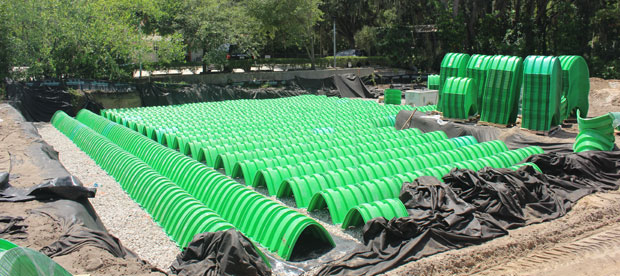
There are many ways of achieving low impact development (LID). The most popular is to incorporate land-based solutions to reduce stormwater runoff through the use of retention ponds, bioswales, infiltration trenches, sustainable pavements (such as pervious concrete), and others noted above. LID can also be achieved by utilizing engineered, manufactured products to achieve similar, or potentially better, results as land-based systems (underground storage tanks, stormwater treatment systems, biofilters, etc.). The proper LID solution is one that balances the desired results (controlling runoff and pollution) with the associated costs (loss of usable land for land-based systems versus capital cost of manufactured solution). Green (vegetated) roofs are also another low cost solution.

IWM as a movement can be regarded as being in its infancy and brings together elements of drainage science, ecology and a realization that traditional drainage solutions transfer problems further downstream to the detriment of our environment and precious water resources.
Education is a key component of stormwater management. A number of agencies and organizations have launched campaigns to teach the public about the problem, and how they can contribute to solving it.

The West Michigan Environmental Action Council (WMEAC) has coined the term Hydrofilth to describe stormwater pollution. This is part of their 15 to the River campaign. WMEAC has taken an active role in preventing Hydrofilth from striking again. They have created a rain barrel distribution program in which they teach people how to have and use a rain barrel in their backyard and educate them on the positive effects it has on combating storm water runoff. Also they have created a website teaching others about how to make their own rain garden.16 WMEAC as well as many other organizations such as the United States Environmental Protection Agency and Clean Water Action are educating people and communities about the problems with storm water runoff and its effects and what they can do in order to prevent further pollution of their waterways from it.

Onion Soaks Up Heavy Metal

Onion and garlic waste from the food industry could be used to mop up hazardous heavy metals, including arsenic, cadmium, iron, lead, mercury and tin in contaminated materials, according to a research paper published in the International Journal of Environment and Pollution.

Biotechnologists Rahul Negi, Gouri Satpathy, Yogesh Tyagi and Rajinder Gupta of the GGS Indraprastha University in Delhi, India, explain how waste from the processing and canning of onion (Allium cepa L.) and garlic (Allium sativum L.) could be used as an alternative remediation material for removing toxic elements from contaminated materials including industrial effluent. The team has studies the influence of acidity or alkalinity, contact time, temperature and concentration of the different materials present to optimize conditions for making a biological heavy metal filter for industrial-scale decontamination.

They have found that at 50 Celsius (122 Fahrenheit), the efficiency of the clean-up process is largely dependent on pH (acidity or alkalinity) and equilibration time usually occurs within half an hour; a pH of 5 was optimal. They demonstrated the maximum extraction was achievable for lead, one of the most troublesome metallic environmental pollutants. They could extract more than 10 milligrams per gram of Allium material from a test solution containing 5 grams per liter of mixed metal ion solution, amounting to recovery efficiency of more than 70%. The absorbed metals can be released into a collecting vessel using nitric acid and the biomass reused.

The team experimented with Allium biomass to demonstrated effective removal of heavy metals from both simulated and actual industrial effluents. “The technique appears to be industrially applicable and viable,” they suggest. “This may provide an affordable, environmental friendly and low maintenance technology for small and medium scale industries in developing countries,” they conclude.

SOURCE: Inderscience Publishers

Usgbc Cces
Triton Stormwater Solutions™, LLC
9864 E. Grand River, Suite 110 #176
Brighton, Michigan 48116
Phone: (810) 222-7652 - Fax: (810) 222-1769
Download-button