
Press Releases

stormwater underground attenuation Australia

Re-occurring and escalating algal blooms and fish kills in Western Australian waterways have resulted in an increased focus on improving stormwater management. Additionally, water restrictions have resulted in more interest in stormwater reuse. Stormwater management aims to build on the traditional objective of local flood protection by having multiple outcomes, including improved water quality management, protected ecosystems, and liveable and attractive communities.

To reflect the new approach to stormwater management, the Manual for Managing Urban Stormwater Quality in Western Australia (Water and Rivers Commission 1998) has been replaced with the Stormwater Management Manual for Western Australia (Department of Water 2004-2007).

Stand-alone chapters have been produced to allow for ease of reference and updating. Please refer to the list below to access chapters of the manual.

A combination of approaches is encouraged, including ‘at-source’ infiltration, non-structural methods such as maintenance of structural controls and training of practitioners, use of more natural water body systems, and structural methods such as swales and infiltration basins.

The manual was developed for local government, industry, developers, State agencies, service providers and community groups. It provides policies and planning principles, as well as on-ground best practice advice. It supports and provides information to enable implementation of Western Australian Planning Commission planning policies and Environmental Protection Authority environmental policies. It also provides specific Western Australian guidance in keeping with the national guides:

This introduction to urban stormwater management has been prepared by Environment Australia as part of the Living Cities Urban Stormwater Initiative. It outlines current challenges and approaches for improving urban stormwater management within a water cycle framework.

This is not a technical manual, rather an analysis of current trends, research and best practice for managing stormwater in Australia. It is a starting point for delving into a feature of our cities that has been often ignored, but is now recognised for its capacity to be both a major source of pollution or a major resource.

Copy and paste this link into your browser to review the document.

http://www.environment.gov.au/coasts/publications/stormwater/

As an example of how Australia is moving forward with its water reuse program the re-elected Gillard Labor Government will help more communities across Australia roll out stormwater projects that assist in securing their future water supplies.

We simply cannot afford to let precious water go to waste.

Based on the strong community interest to date, Prime Minister Julia Gillard today announced the Stormwater Harvesting and Reuse program would receive a significant boost.

The Prime Minister also announced that Waterproofing Eastern Adelaide will be the first project to be funded from the expanded program.

This project brings together the Burnside, Norwood, Payneham, St Peters, Campbelltown, Tea Tree Gully and Town of Walkerville councils to create a network of stormwater capture, storage and distribution sites across eastern Adelaide.

Apart from initial feasibility assistance, funding for this project will be shared by the Australian Government, South Australian Government and local councils.

The Gillard Government would provide up to $10 million for the project, subject to confirmation of funds from the partner organisations and finalisation of the feasibility study.

The remaining projects bidding for funds under the expanded program will need to demonstrate they can help ease pressure on drinking water supplies and deliver improved water quality to our urban waterways.

Treated stormwater can be used to maintain sporting ovals, parks, and gardens, or by local businesses and industry.

By investing in over 160 urban water projects to date – including stormwater, desalination and recycling – the Gillard Labor Government is helping prepare Australia for a future with less water.

The expanded program announced today will help even more Australian communities harvest and treat stormwater, improving urban water security.

The expansion, worth $100 million, is drawn from the National Urban Water and Desalination Plan, already included in the Budget.

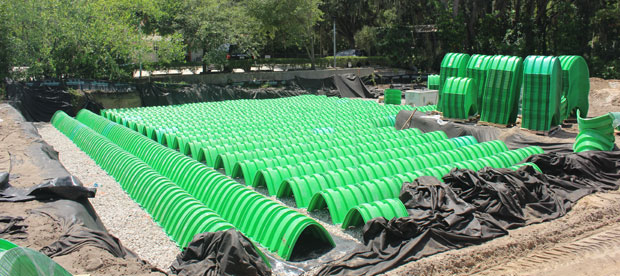
With the extensive information that is listed above it is very important to use a product that will meet these demands and provide a long lasting solutions so Why Choose Triton Stormwater Solutions™?

Triton Stormwater Solutions™ manufactures the next generation of stormwater underground chamber management systems. Greater capacity, ease of chamber installation and superior strength make Triton Stormwater Solutions™ the professionals’ choice. In virtually every metric that matters to developers, municipal planners and engineers, Triton Stormwater Solutions™ chambers offer important advantages over any system currently in use.

Infiltration Problems-Down The Drain

Stormwater professionals have long acknowledged the water-quality problems associated with car washing, not only with centralized car washing services that direct water to the storm drains, but also with individuals who wash their own cars in their driveways or in the street. In both cases—unless the car wash either recycles the water or directs it to the sanitary sewer, and unless the person washing a car in the driveway has some means to capture the water—the detergent and whatever else comes off the car goes straight to the storm drain.

But nothing, perhaps, makes stormwater managers cringe as much as local fundraising car washes, which seem to take place on just about every sunny weekend—high school sports teams, band members, scout troops, or local charities raising money by washing dozens of vehicles on a convenient vacant lot.

Studies have been done to quantify how much harm the practice might actually cause to surface waters, as in this study in the Puget Sound area. Some stormwater programs have encouraged fundraising groups to hold their events at a professional car wash instead, where the water is properly handled. In addition to keeping it out of the storm drain, studies have estimated that a commercial car washes uses 60% less water than washing with a hose, in part because the pressure nozzles mix air with the water to create high pressure with less water volume.

Alternatively, many organizations and local governments provide home car-washing kits [http://www.stormh2o.com/SW/Articles/7625.aspx] to local residents, including catch basin inserts to trap and divert the soapy water. The use of such kits has been especially encouraged for community fundraising car wash events. Prohibiting the fundraisers outright proved to be extremely unpopular, however.

The water-quality message finally seems to be getting through, though, at least in some places. Officials in Washington state say the traditional vacant-lot car wash is dying out. Three-quarters of people surveyed now say the practice should be discontinued. Fundraising groups are looking to alternatives, such as partnering with a professional car wash to offer car-washing coupons. And there’s even some evidence that people who do pay for their car to be washed by a local group are more likely to ask where the runoff goes—evidence that the public education message is actually getting through.

Senate Committee Approves WIFIA

Denver — A US Senate Committee today passed legislation that would create a Water Infrastructure Finance and Innovation Authority, a development the American Water Works Association hailed as pivotal in confronting America’s trillion-dollar water infrastructure challenge.

If enacted into law, WIFIA would make low-interest federal loans available to address large water infrastructure projects in communities across the United States. AWWA, a chief proponent for the creation of WIFIA for several years, is urging water utilities and businesses across the water sector to actively support the bill as it heads to the full Senate.

“Today represents a pivotal moment in assuring America’s water infrastructure challenge is no longer buried,” said AWWA Executive Director David LaFrance. “WIFIA would help communities repair more critical water infrastructure at a lower cost. Ultimately, WIFIA would benefit everyone who pays a water bill.”

Based on a successful financing tool in the transportation sector, WIFIA would aid communities with pipe replacement, new or upgraded treatment plants, wastewater, reuse and desalination projects, and new water supply projects. The provision is part of the Water Resources Development Act of 2013, which is expected to reach the Senate floor by May of 2013.

“Committee Chair Barbara Boxer and Ranking Member David Vitter should be recognized for their exemplary bi-partisan effort to advance such a significant water infrastructure bill,” LaFrance said.

AWWA in 2012 published a comprehensive water infrastructure report titled “Buried No Longer: Confronting America’s Water Infrastructure Challenge,” demonstrating that more than $1 trillion will be required over the next 25 years to repair and expand existing drinking water infrastructure. The report noted that local utility customers will bear the cost of renewal through higher water rates, but that “states and the federal government can help with a careful and cost-effective program that lowers the cost of necessary investments to our communities, such as the creation of a credit support program — for example, AWWA’s proposed Water Infrastructure Finance and Innovation Authority.”

SOURCE: American Water Works Association

Usgbc Cces
Triton Stormwater Solutions™, LLC
9864 E. Grand River, Suite 110 #176
Brighton, Michigan 48116
Phone: (810) 222-7652 - Fax: (810) 222-1769
Download-button